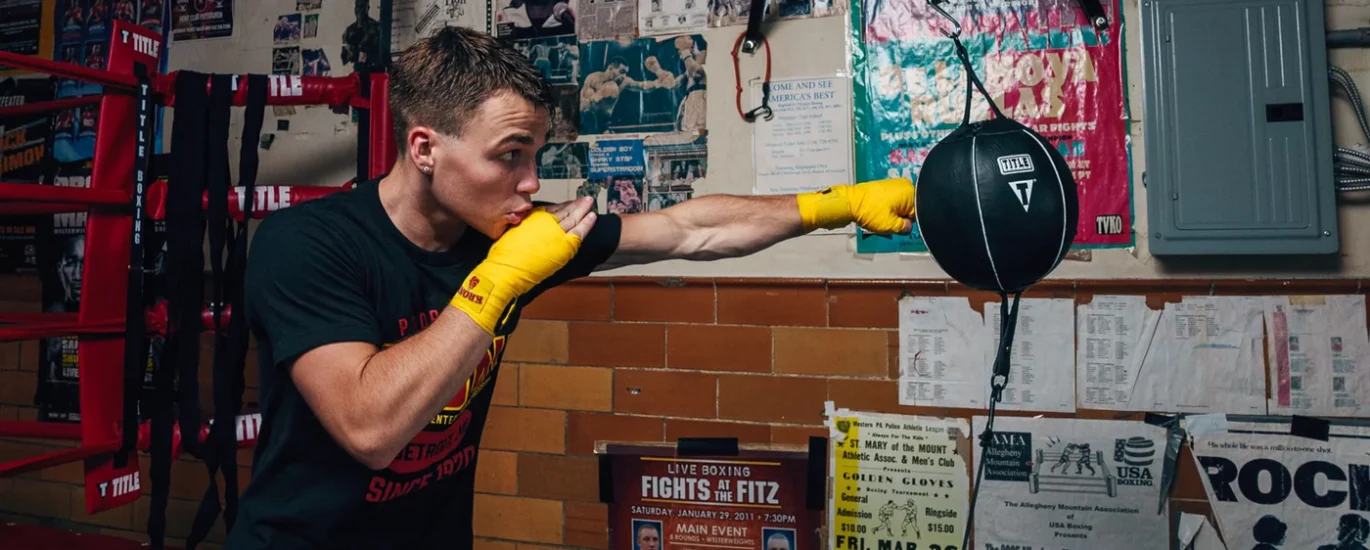
In boxing, speed and power are important, but the ability to land punches accurately while maintaining good timing can make all the difference. One of the best training tools for developing these skills is the double-end bag.
Unlike the heavy bag, which primarily helps develop punching technique, power, and conditioning, the double-end bag challenges a boxer’s accuracy, coordination, reaction time, and ability to maintain rhythm.
The bag moves unpredictably after being struck, forcing the boxer to stay focused, judge distance, and time their punches.
Many experienced boxers incorporate double-end bag training into their routines because it helps develop skills that translate into real boxing situations.
Whether you’re a beginner learning the fundamentals or an experienced fighter sharpening your technique, the double-end bag deserves a place in your boxing training.
What Is a Double-End Bag?
A double-end bag is a small boxing bag connected to the floor and ceiling by elastic cords.
Unlike a traditional heavy bag, it moves quickly in different directions when punched.
The movement creates a challenging target that requires the boxer to develop accuracy, timing, coordination, and hand-eye coordination.
A double-end bag allows you to practice:
- Jabs and crosses.
- Hooks and combinations.
- Punching accuracy.
- Hand speed.
- Reaction time.
- Defensive head movement.
- Distance management.
- Rhythm and timing.
The goal is not simply to hit the bag as hard as possible. It is to develop control and consistently connect with a moving target.
Why Double-End Bag Training Is Important
1. Improves Hand-Eye Coordination
The moving bag challenges you to coordinate your eyes and hands. You must track its movement and connect with it accurately.
2. Develops Punching Accuracy
Unlike a large heavy bag, the double-end bag provides a much smaller target.
This encourages you to become more precise with your punches.
3. Improves Timing
The bag moves continuously, requiring you to recognize its rhythm and choose the appropriate moment to punch.
4. Develops Reaction Time
You must react to the bag’s movement and adjust your positioning as it travels toward or away from you.
5. Improves Defensive Awareness
The bag can move back toward your head after being struck, giving you an opportunity to practice defensive movement and positioning.
6. Builds Rhythm and Coordination
Consistent practice helps develop smoother transitions between punches, defensive movements, and footwork.
10 Double-End Bag Drills Every Boxer Should Practice
1. Basic Jab Drill
The jab is the perfect starting point for double-end bag training.
Begin by practicing controlled jabs and concentrating on making clean contact with the moving target.
Training focus:
- Hand-eye coordination.
- Accuracy.
- Timing.
- Distance awareness.
- Punch recovery.
Suggested duration: 2 minutes.
2. Jab-Cross Combination Drill
Once you become comfortable with the jab, introduce the cross.
Practice connecting with the moving bag using controlled one-two combinations.
Training focus:
- Coordination between both hands.
- Punching rhythm.
- Accuracy.
- Maintaining balance.
Suggested duration: 2 minutes.
3. Double Jab Drill
This drill focuses on throwing two consecutive jabs while maintaining control of your distance and positioning.
It helps develop lead-hand coordination and consistency.
Training focus:
- Lead-hand speed.
- Accuracy.
- Rhythm.
- Punch recovery.
Suggested duration: 2 minutes.
4. Hook Combination Drill
Introduce lead and rear hooks into your double-end bag routine.
Start slowly and focus on making controlled contact with the moving target.
Training focus:
- Coordination.
- Punching accuracy.
- Balance.
- Combination control.
Suggested duration: 2 minutes.
5. Uppercut Drill
Uppercuts add another dimension to your double-end bag training.
Practice controlled lead and rear uppercuts while maintaining your boxing stance.
Focus on technique rather than trying to generate maximum power.
Training focus:
- Punching mechanics.
- Coordination.
- Timing.
- Defensive positioning.
Suggested duration: 2 minutes.
6. Speed Punching Drill
This drill focuses on developing faster hand movement while maintaining accuracy.
Practice short combinations at different speeds. Avoid sacrificing technique just to increase your punching rate.
Training focus:
- Hand speed.
- Reaction time.
- Coordination.
- Consistency.
Suggested duration: 2 minutes.
7. Slip and Counter Drill
The double-end bag is particularly useful for practicing defensive awareness.
As the bag moves back toward you, incorporate controlled slipping movements and return to your boxing stance.
Use light, technically controlled punches rather than trying to overpower the bag.
Training focus:
- Head movement.
- Defensive awareness.
- Balance.
- Coordination.
Suggested duration: 2 minutes.
8. Footwork and Distance Drill
Avoid standing in one position throughout your entire double-end bag session.
Practice making small adjustments to your positioning while maintaining your boxing stance.
Training focus:
- Footwork.
- Distance management.
- Balance.
- Movement coordination.
Suggested duration: 2 minutes.
9. Combination Flow Drill
This drill brings several fundamental punches together.
Practice combinations that include jabs, crosses, and hooks while maintaining a comfortable rhythm.
Focus on accuracy and smooth transitions.
Training focus:
- Combination punching.
- Timing.
- Rhythm.
- Hand-eye coordination.
Suggested duration: 3 minutes.
10. Freestyle Double-End Bag Drill
The freestyle round allows you to combine everything you have practiced.
Move around the bag, throw controlled combinations, incorporate defensive movements, and maintain your boxing stance.
Think about the bag as a moving opponent rather than a stationary target.
Training focus:
- Accuracy.
- Timing.
- Reflexes.
- Footwork.
- Overall coordination.
Suggested duration: 3 minutes.
A 20-Minute Double-End Bag Workout
Here is a structured routine for developing your double-end bag skills.
| Round | Training focus | Duration |
|---|---|---|
| 1 | Basic jab | 2 min |
| 2 | Jab and cross | 2 min |
| 3 | Double jab | 2 min |
| 4 | Hooks | 2 min |
| 5 | Uppercuts | 2 min |
| 6 | Speed punching | 2 min |
| 7 | Slip and counter | 2 min |
| 8 | Footwork and distance | 2 min |
| 9 | Combination flow | 2 min |
| 10 | Freestyle | 2 min |
Rest for 30–60 seconds between rounds as needed. Beginners can start with fewer rounds and gradually build up.
Famous Boxers and Double-End Bag Training
Many legendary fighters have demonstrated the importance of accuracy, timing, and hand speed through their boxing training.
Floyd Mayweather Jr.
Floyd Mayweather is widely recognized for his exceptional accuracy, defensive awareness, and hand speed.
His technical approach to boxing highlights the importance of precision and controlling the distance between yourself and an opponent.
Sugar Ray Leonard
Sugar Ray Leonard was known for his quick combinations, fluid movement, and excellent coordination.
His fighting style demonstrates why timing and accuracy are essential skills for a complete boxer.
Muhammad Ali
Muhammad Ali’s speed, reflexes, and movement made him one of boxing’s most recognizable champions.
His style illustrates the importance of staying relaxed, moving efficiently, and maintaining awareness throughout a fight.
Manny Pacquiao
Manny Pacquiao became famous for his explosive hand speed, combination punching, and unusual angles.
His boxing style demonstrates the importance of coordination, rhythm, and maintaining offensive activity.
Common Double-End Bag Training Mistakes
Although the double-end bag looks simple, beginners often struggle when first learning