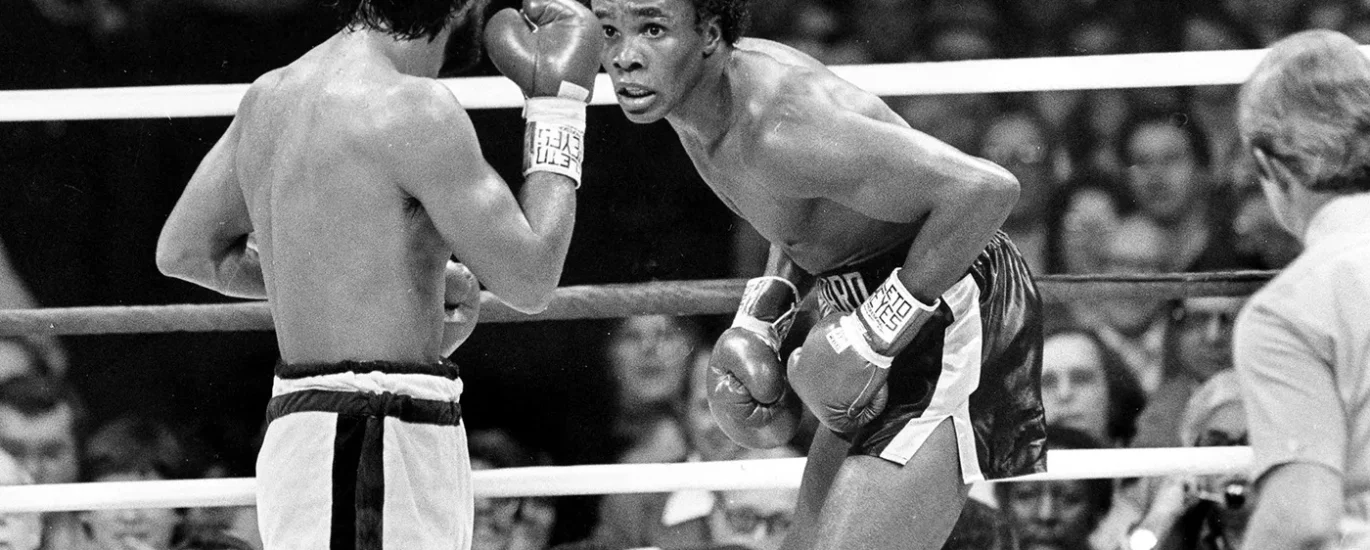
When discussing the greatest boxers in history, Sugar Ray Leonard is a name that deserves recognition. Known for his incredible hand speed, footwork, boxing intelligence, charisma, and ability to perform under pressure, Leonard became one of the most celebrated fighters of his generation.
He was more than just a talented boxer. He was an entertainer, a competitor, and a fighter who knew how to adapt when facing different styles and challenges.
From his Olympic success to his legendary rivalries with Roberto Durán, Thomas Hearns, and Marvin Hagler, Sugar Ray Leonard built a career that helped define an unforgettable era in boxing.
Early Life and Introduction to Boxing
Sugar Ray Leonard was born Ray Charles Leonard on May 17, 1956, in Wilmington, North Carolina. He grew up in Maryland, where he eventually discovered his passion for boxing.
Leonard began boxing as a teenager and quickly demonstrated natural athletic ability. His speed, coordination, and willingness to learn helped him develop into an outstanding amateur fighter.
His amateur career reached its peak at the 1976 Olympic Games in Montreal, where he won a gold medal in the light welterweight division.
That Olympic victory introduced Leonard to a much larger audience and helped launch his professional boxing career.
The Rise of a Professional Champion
Leonard turned professional in 1977 and quickly became one of boxing’s rising stars.
His fighting style was built around speed, movement, combinations, and precision. Unlike fighters who relied primarily on knockout power, Leonard could control a fight using his footwork and ability to change rhythm.
He became a world champion in five weight divisions:
-
- Welterweight
-
- Light middleweight
-
- Middleweight
-
- Super middleweight
-
- Light heavyweight
His ability to compete successfully across multiple weight classes demonstrated his versatility and technical ability.
Leonard eventually retired with a professional record of 36 wins, 3 losses, and 1 draw, including 25 victories by knockout.
The Rivalries That Defined His Career
One of the most exciting aspects of Sugar Ray Leonard’s career was his rivalry with some of the greatest fighters of his generation.
1. Sugar Ray Leonard vs. Roberto Durán
<AsyncImageGroup query={[“Sugar Ray Leonard Roberto Duran 1980 boxing fight”,”Sugar Ray Leonard Roberto Duran No Mas fight 1980″]} aspectRatio=”5:4″ layout=”bento”/>
The rivalry between Leonard and Roberto Durán became one of boxing’s most memorable stories.
Their first fight took place in June 1980, when Durán defeated Leonard by unanimous decision. Durán’s aggressive pressure and relentless fighting style created serious problems for Leonard.
However, their rematch later that year produced a dramatic turnaround. Leonard used movement and boxing skills to frustrate Durán, who famously stopped fighting in the eighth round, saying “No Más.”
The two fights became a defining chapter in boxing history.
2. Sugar Ray Leonard vs. Thomas Hearns
<AsyncImageGroup query={[“Sugar Ray Leonard Thomas Hearns 1981 boxing fight”,”Leonard Hearns 1981 boxing championship”]} aspectRatio=”5:4″/>
The 1981 showdown between Leonard and Thomas Hearns was another historic event.
Hearns possessed tremendous reach, speed, and punching power. Leonard had to overcome a difficult challenge against a fighter who could control distance with his long jab.
After a competitive fight, Leonard stopped Hearns in the 14th round.
Their rivalry continued years later with a 1989 rematch that ended in a draw.
3. Sugar Ray Leonard vs. Marvin Hagler
<AsyncImageGroup query={[“Sugar Ray Leonard Marvin Hagler 1987 boxing fight”,”Marvin Hagler Sugar Ray Leonard championship fight”]} aspectRatio=”5:4″/>
In April 1987, Leonard returned to the ring to face middleweight champion Marvin Hagler.
It was one of the most anticipated fights of the decade.
Hagler was known for his toughness, pressure, and ability to fight at a high pace. Leonard relied on speed, movement, combinations, and carefully managed exchanges.
After 12 rounds, Leonard won by split decision.
The result remains one of the most discussed decisions in boxing history, with fans continuing to debate the fight decades later.
What Made Sugar Ray Leonard Special?
Leonard possessed a combination of skills that made him difficult to prepare for.
1. Incredible Hand Speed
Leonard could throw fast combinations and catch opponents before they had time to respond.
2. Excellent Footwork
His movement allowed him to control distance, create angles, and avoid unnecessary exchanges.
3. Boxing Intelligence
He understood how to adjust his strategy depending on his opponent’s strengths and weaknesses.
4. Combination Punching
Leonard was particularly effective at putting punches together. His combinations were fast, fluid, and often difficult to defend.
5. Adaptability
Perhaps one of his greatest qualities was his ability to change his fighting style. He could box from the outside, fight aggressively, or adjust his approach when circumstances demanded it.
Sugar Ray Leonard’s Boxing Style
Leonard was a versatile boxer who combined traditional boxing fundamentals with exceptional athleticism.
He could use his jab to establish distance, move around the ring, throw combinations, and create opportunities through changes in speed and rhythm.
His style also demonstrated the importance of being able to switch between offense and defense.
Rather than depending on one particular approach, Leonard adapted to what each opponent presented.
For young boxers, his career provides valuable lessons in developing a complete skill set.
Life Beyond the Boxing Ring
Sugar Ray Leonard’s influence extended beyond professional boxing.
His popularity made him one of the sport’s most recognizable personalities. He appeared in television programs, became involved in motivational speaking, and worked as a boxing commentator and public figure.
He also became involved in charitable work, including efforts supporting young people and families affected by substance abuse.
His success helped demonstrate how a professional boxer could build a career and public identity beyond competition.
Lessons Young Boxers Can Learn From Sugar Ray Leonard
Leonard’s career offers several important lessons for anyone learning the sport.
-
- Develop your speed: Quick hands and good coordination can make a significant difference.
-
- Master your footwork: Movement is an essential part of both offense and defense.
-
- Learn to adapt: Different opponents require different approaches.
-
- Improve your combinations: Being able to put punches together is an important boxing skill.
-
- Stay disciplined: Consistent training and preparation are essential to long-term development.
-
- Build confidence: Believe in your abilities while remaining willing to learn.
Sugar Ray Leonard’s Legacy
Sugar Ray Leonard helped define one of the most memorable periods in boxing history.
His rivalries with Roberto Durán, Thomas Hearns, and Marvin Hagler brought enormous attention to the sport and created fights that fans still discuss today.
His Olympic gold medal, world championships in five weight divisions, and ability to compete against elite opponents established his place among boxing’s most celebrated champions.
Leonard showed the world that boxing is not just about strength or power. It is also about speed, timing, intelligence, adaptability, and heart.
Final Thoughts
Sugar Ray Leonard’s journey from a young amateur boxer to an international sports icon is an inspiring story of dedication and achievement.
He possessed the athletic ability to compete at the highest level, but his willingness to adapt and overcome difficult challenges helped separate him from many other fighters.
Whether fans remember him for his Olympic gold medal, his unforgettable rivalries, or his exciting fighting style, his influence on boxing remains significant.
Sugar Ray Leonard proved that greatness in boxing is about more than winning fights. It is about mastering the craft, overcoming challenges, and leaving a legacy that inspires future generations.