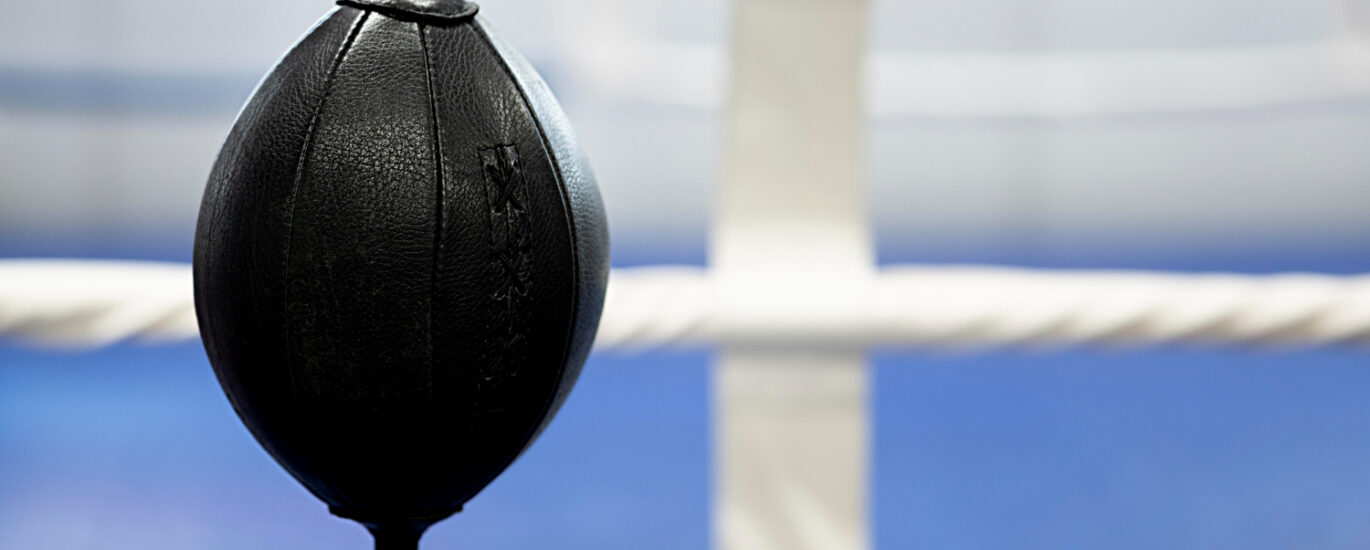
The double-end bag may be smaller than the heavy bag, but it can be one of the most challenging and valuable pieces of equipment in a boxing gym.
Unlike a heavy bag, the double-end bag moves quickly after you hit it. It comes back toward you, changes direction, and forces you to react. That makes it an excellent tool for developing timing, accuracy, hand speed, rhythm, defense, and hand-eye coordination.
The goal isn’t to overpower the bag. It’s to learn how to control it.
What Is the Double-End Bag?
A double-end bag is a small bag attached to elastic cords at both the top and bottom. When punched, it quickly rebounds back and forth.
Because of this movement, you can’t simply plant your feet and throw power punches.
You have to watch the bag, anticipate where it will move, time your punches, and react when it comes back.
That makes the double-end bag much closer to a moving target than a traditional heavy bag.
Start With the Jab
Don’t begin by trying to throw complicated combinations.
Start with your jab.
Hit the bag lightly and watch how it responds. Allow it to rebound and then time your next jab.
The objective is to find the rhythm.
Jab → Watch → Jab → Move
As you become more comfortable, add double jabs and begin changing your position around the bag.
Accuracy matters more than power.
Add the Cross
Once you can consistently land the jab, introduce your rear hand.
Start working:
Jab → Cross
Keep the combination controlled.
The bag will move considerably more once you start throwing combinations, so pay attention to its return path.
Don’t chase it with your hands.
Stay balanced and allow the bag to return into punching range.
Develop Your Timing
Timing is one of the biggest benefits of double-end bag training.
You aren’t punching a stationary target. You’re trying to land on something that is constantly moving.
Sometimes you should hit the bag immediately.
Other times you should allow it to rebound before punching again.
This teaches you that boxing isn’t always about throwing faster.
Sometimes the better punch is the one thrown at exactly the right moment.
Practice Head Movement
The double-end bag can also help develop defensive awareness.
After throwing a combination, allow the bag to come back toward you and move your head out of its path.
Try:
Jab → Cross → Slip
or:
Jab → Cross → Roll
You can also throw a combination, step away, and allow the bag to pass before attacking again.
This creates the habit of combining offense with defense.
Work on Accuracy
A heavy bag gives you a large target.
The double-end bag doesn’t.
You need to concentrate on landing your punches in a relatively small area.
That makes it excellent for improving punching accuracy.
Instead of throwing punches wildly, focus your eyes on the center of the bag and make every punch deliberate.
As your accuracy improves, gradually increase your speed.
Don’t Try to Knock It Out
One of the biggest mistakes beginners make is trying to hit the double-end bag too hard.
Power isn’t the primary objective.
If you smash the bag with every punch, it can become difficult to control and you may spend more time chasing it than actually training.
Start with lighter punches.
Develop your rhythm.
Once you understand how the bag moves, you can gradually increase your speed and power while maintaining control.
Move Your Feet
Don’t allow double-end bag training to become a stationary exercise.
Move around the bag.
Step left.
Step right.
Circle.
Step back.
Change angles.
Then punch again.
Combining footwork with the unpredictable movement of the bag creates a much more realistic boxing drill.
Change Your Rhythm
Don’t always punch at the same speed.
Throw a slow jab.
Pause.
Throw a fast one-two.
Move.
Double jab.
Pause again.
Changing your rhythm makes the drill more challenging and teaches you to avoid becoming predictable.
This is especially important when transitioning skills into sparring.
Use Different Combinations
Once you become comfortable controlling the bag, begin experimenting with combinations.
Try:
Jab → Cross
Double Jab → Cross
Jab → Cross → Lead Hook
Jab → Body Cross → Lead Hook
Cross → Lead Hook → Cross
Don’t worry if you miss occasionally.
Missing is part of the exercise. Reset your stance, find the bag again, and continue.
Don’t Forget Your Defense
The double-end bag can encourage you to become completely focused on hitting the target.
Remember that boxing is both offense and defense.
After your combinations:
Slip.
Roll.
Pivot.
Step back.
Move your head.
Reset your guard.
Imagine the bag’s return as an opponent throwing a counterpunch.
Relax and Find the Rhythm
Double-end bag training becomes much easier when you stop trying to force it.
Stay relaxed.
Keep your shoulders loose.
Watch the bag.
Breathe.
Let your punches flow.
As your timing improves, you’ll begin to understand the bag’s rhythm and anticipate where it will be rather than reacting at the last possible moment.
A Small Bag With Big Benefits
The double-end bag doesn’t develop boxing skills in exactly the same way as the heavy bag.
That’s what makes it so valuable.
The heavy bag is excellent for developing combinations, power, and conditioning. The double-end bag challenges your timing, accuracy, reactions, coordination, rhythm, and defensive movement.
Use both.
Learn to hit a stationary target with proper mechanics, then challenge yourself against a target that refuses to stay still.
Don’t just hit the double-end bag. Read it, time it, move with it, and learn to control the rhythm.