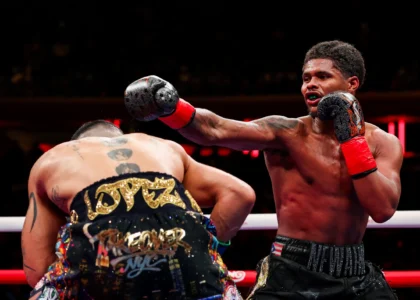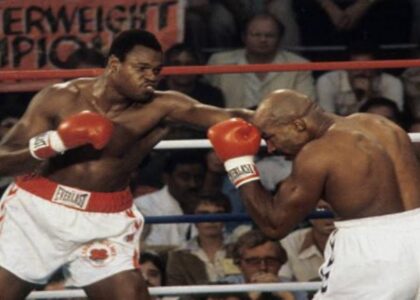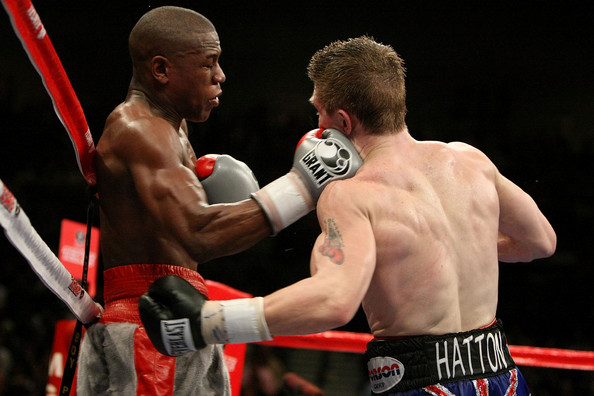
The right hook is a powerful punch that can become an important part of an orthodox boxer’s offense, particularly at close and mid-range.
Unlike the straight right, which travels directly toward the opponent, the right hook attacks from the side. This gives a boxer another angle of attack and can make the punch useful when an opponent is protecting the center of their guard.
But the right hook isn’t simply a big swing with the rear hand.
An effective right hook requires proper distance, hip rotation, balance, timing, and compact technique. Throw it correctly and the entire body contributes to the punch. Throw it too wide or from too far away, and you can leave yourself exposed.
What Is the Right Hook?
For an orthodox boxer, the right hook is a hook thrown with the rear hand.
Instead of traveling straight like the cross, the right hand follows a curved path toward the target.
The punch can be directed toward the head or body and is often most useful when you’re already relatively close to your opponent.
Because it comes from the rear side, the right hook can generate significant force when combined with proper body rotation.
Start With the Right Distance
Distance is one of the most important parts of throwing a right hook.
The rear hand begins farther away from the opponent than the lead hand. That means trying to throw a rear hook from long range can cause you to reach or swing excessively.
Don’t force the punch.
If you’re at long range, a straight right may be the better option.
As you move closer, the right hook becomes more available.
Use the right punch for the right distance.
How to Throw the Right Hook
Begin in your normal orthodox stance.
Keep your hands up, chin tucked, knees slightly bent, and weight balanced.
As you throw the right hook, rotate your rear hip and shoulder toward the target.
Your rear foot should turn naturally with the movement.
The arm follows the body’s rotation rather than swinging independently.
Think:
Foot → Hip → Torso → Shoulder → Fist
The entire body works together.
Rotate Through the Hips
The hips are one of the primary sources of power for the right hook.
As the punch travels, rotate your rear hip forward.
Your torso and shoulder follow.
This allows the punch to use your entire body rather than relying only on your arm.
Avoid overrotating.
You should finish the punch balanced enough to immediately defend, move, or continue punching.
Keep the Hook Compact
One of the biggest mistakes with the right hook is making it too wide.
A huge looping punch may feel powerful, but it takes longer to reach the target and gives your opponent more time to react.
It can also expose your chin.
Keep the hook tight.
The exact arc will depend on your distance from the opponent, but unnecessary movement should always be avoided.
Shorter punches are generally faster punches.
Don’t Pull the Hand Back
Avoid loading the right hook by pulling your glove backward before throwing.
That’s a telegraph.
An experienced opponent may recognize the movement and react before the punch arrives.
Throw from your normal guard.
The rotation of your body should create the power.
You shouldn’t need a giant windup.
Keep Your Left Hand Up
When your right hand leaves your face, your left hand becomes extremely important defensively.
Keep it protecting your chin and the side of your face.
Don’t allow both hands to drop while trying to generate power.
Remember:
Every punch creates an opening. Good technique minimizes that opening.
Right Hook to the Head
The right hook to the head can be useful when you’re close enough that a straight right no longer has ideal punching room.
Rotate through the body and bring the punch around toward the side of the opponent’s guard.
Don’t reach.
If you’re too far away, reposition before throwing.
After the punch lands or misses, bring the hand immediately back into defensive position.
Right Hook to the Body
The right hook can also be directed downstairs.
Change levels through your knees rather than dramatically bending forward at the waist.
Rotate the hips and deliver a compact hook toward the legal scoring area of the torso.
Keep your opposite hand protecting your face.
Then return to your stance.
Body punching should never leave you stuck in a low position.
Set Up the Right Hook With the Jab
The jab can help create opportunities for almost every rear-hand punch.
Try:
Jab → Right Hook
The jab occupies the opponent’s attention with a straight attack.
The right hook then approaches from a different angle.
The combination also changes the rhythm compared with the more familiar jab-cross.
Left Hook-Right Hook
At closer range, alternating hooks can create a natural rotational combination:
Left Hook → Right Hook
The left hook rotates your body toward one side.
That movement can help prepare the opposite side to return with the right hook.
Stay controlled.
Don’t turn the combination into two huge swings.
Think about rotating through your body while keeping both punches compact.
Right Hook-Left Hook
You can also reverse the sequence:
Right Hook → Left Hook
The right hook rotates the body.
The left side then returns.
This can work particularly well at close range where both hooks can travel short distances.
The important thing is maintaining balance between punches.
Cross-Left Hook-Right Hook
A useful combination is:
Cross → Left Hook → Right Hook
The cross attacks straight through the middle.
The left hook changes the angle.
The right hook follows from the opposite side.
This gives the opponent several different defensive problems in rapid succession.
Don’t throw every punch at maximum power.
Allow the combination to flow.
Right Hook to the Body-Left Hook to the Head
Changing levels makes hooks more difficult to defend.
Try:
Right Hook Body → Left Hook Head
The first punch directs the opponent’s attention downstairs.
The second comes upstairs from the opposite side.
You can also reverse the targets:
Right Hook Head → Left Hook Body
Mixing head and body attacks forces the opponent to continually adjust their guard.
Use the Right Hook After a Roll
Defensive movement can help create opportunities for hooks.
After rolling underneath an opponent’s punch, your body may already be positioned to rotate into the right hook.
For example:
Roll → Right Hook
or:
Roll → Right Hook → Left Hook
This is where defense and offense begin working together.
The defensive movement helps load the counterattack.
Don’t Throw It From Too Far Away
A right hook thrown from outside its proper range can become slow and easy to see.
If you have to reach dramatically or swing your arm around to find the opponent, you’re probably too far away.
Use the cross at longer range.
Use your feet to close distance.
Then use the hook when you’re in position.
Distance should determine your punch selection.
Don’t Overrotate
Power can become a problem when it destroys your balance.
If you throw the right hook so hard that your entire body spins past the opponent, you’ve created an opportunity for them to counter.
Your punch should finish with you still capable of boxing.
Ask yourself after throwing:
Can I immediately defend?
Can I throw another punch?
Can I move?
If not, reduce the rotation.
Practice the Right Hook on the Heavy Bag
The heavy bag is an excellent place to develop the mechanics.
Start close enough that you don’t need to reach.
Throw one right hook.
Reset.
Check your balance.
Repeat.
Then begin adding combinations:
Left Hook → Right Hook
Right Hook → Left Hook
Cross → Left Hook → Right Hook
Right Hook Body → Left Hook Head
Move around the bag between combinations.
Don’t stand in one position throwing hooks endlessly.
Practice on the Mitts
Focus mitts can help you understand when the right hook is actually available.
A trainer can change distance and angles while presenting different targets.
At longer range, you may need the cross.
At closer range, the right hook becomes available.
Learning to recognize that difference is an important part of developing punch selection.
Speed Before Maximum Power
The rear hook can feel powerful, which often encourages beginners to throw it as hard as possible.
Resist that temptation.
First develop:
Balance
Rotation
Accuracy
Speed
Recovery
Once those mechanics become efficient, power will follow.
A fast, compact hook that lands cleanly is more useful than a huge swing that misses.
Add the Right Hook to Your Arsenal
The right hook gives an orthodox boxer another powerful attacking angle.
Use the straight right when the distance calls for it.
Use the right hook when the range becomes shorter and the angle becomes available.
Rotate through the hips.
Keep the punch compact.
Protect yourself with the opposite hand.
Don’t overreach.
And always recover your stance after throwing.
Because the right hook isn’t about swinging your rear hand as hard as possible.
It’s about putting your entire body behind a short, accurate punch—and delivering it from an angle your opponent isn’t prepared to defend.