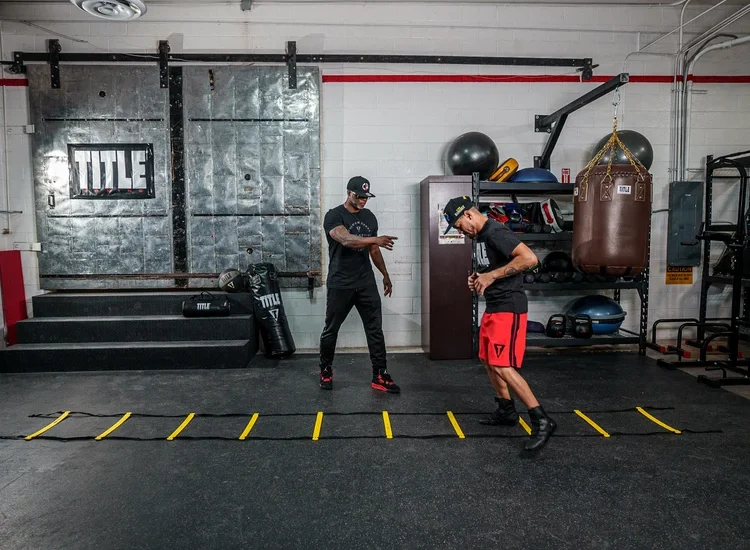
Good boxing starts from the ground up. Punching power, defense, angles, and combinations all depend on a fighter’s ability to control their feet. One training tool that can help develop quicker, more coordinated movement is the agility ladder.
The agility ladder isn’t designed to teach boxing footwork by itself. Instead, it can help develop some of the physical qualities that support good footwork, including coordination, rhythm, balance, speed, and body control.
When incorporated correctly into a boxing workout, ladder drills can be a useful addition for beginners and experienced fighters alike.
Why Footwork Matters in Boxing
A boxer who can move efficiently has more options in the ring. Good footwork allows you to close distance, escape pressure, create punching angles, maintain balance, and reposition yourself before your opponent can react.
The goal isn’t simply to have fast feet.
A boxer needs fast feet that remain under control.
Moving quickly doesn’t help if your feet cross, your stance becomes too narrow, or you lose your balance every time you change direction. This is why footwork training should emphasize precision before speed.
The agility ladder provides a structured environment for developing that coordination.
What Does the Agility Ladder Train?
Ladder drills require a boxer to place their feet quickly and accurately into relatively small spaces. Different patterns challenge the body to move forward, backward, sideways, and diagonally.
Regular practice can help work on:
Foot speed: Rapid ladder patterns encourage quick contact with the floor.
Coordination: Fighters learn to synchronize their upper and lower bodies while following different movement patterns.
Rhythm: Boxing requires constant changes in tempo. Ladder drills can help fighters become more comfortable moving at different speeds.
Balance: Good drills require the athlete to stay centered while the feet move quickly underneath the body.
Direction changes: Lateral and diagonal drills can prepare the body for the quick directional movements frequently used during boxing.
These abilities can complement boxing-specific exercises such as shadowboxing, bag work, mitt work, and partner drills.
Basic Ladder Drills for Boxers
You don’t need complicated patterns to get value from an agility ladder. In many cases, simple drills performed correctly are more beneficial than elaborate movements performed poorly.
One Foot in Each Square
Move forward through the ladder while placing one foot in each square.
Keep your steps quick and light while maintaining good posture. Avoid looking down continuously. As your coordination improves, try keeping your eyes forward.
This is one of the easiest ways to introduce ladder training.
Two Feet in Each Square
Place both feet inside each square before advancing to the next.
For example:
Left foot → right foot → next square → repeat.
The drill develops rhythm and requires faster foot placement than the one-foot variation.
Once comfortable, increase the pace without sacrificing control.
Lateral Two-In Drill
Turn sideways to the ladder and move laterally through it, placing both feet into each square.
This movement can be particularly useful for boxers because lateral movement is essential when creating angles or moving away from an opponent’s attack.
Perform the drill moving in both directions so one side doesn’t become significantly more coordinated than the other.
The Ickey Shuffle
The Ickey Shuffle is one of the most recognizable agility ladder exercises.
The basic pattern involves moving through the ladder with two feet entering a square while the outside foot steps alongside the ladder before progressing to the next square.
The pattern develops coordination, rhythm, and lateral movement.
Don’t rush when learning it.
Start slowly enough to understand the sequence. Once the movement becomes automatic, gradually increase your speed.
In-In-Out-Out
Start outside the ladder.
Step both feet inside a square and then step both feet outside before advancing to the next square.
Think:
In → In → Out → Out.
This drill requires rapid changes in foot position while maintaining balance.
Boxers can eventually add small upper-body movements or punches once the foot pattern becomes comfortable.
Forward and Backward Ladder Drill
Boxers need to be comfortable moving backward as well as forward.
Move forward through several squares before reversing direction and moving backward.
The objective isn’t simply to complete the ladder quickly. Concentrate on maintaining posture and controlling your center of gravity as you change direction.
This can help reinforce the ability to accelerate, stop, and reverse direction.
Connect Ladder Drills to Boxing
One common mistake is treating agility ladder training as if it were boxing footwork.
It isn’t.
A boxer doesn’t fight while trying to place their feet into imaginary squares on the canvas.
The ladder is a training tool, not a replacement for boxing-specific movement.
A useful approach is to immediately connect a ladder drill with a boxing movement.
For example, move quickly through the ladder and then step into your boxing stance. From there:
Ladder → Jab-Cross → Pivot
or
Ladder → Jab → Step Out
or
Ladder → Combination → Lateral Exit
or
Ladder → Slip → Counter → Pivot
Now the coordination developed on the ladder has to transition into actual boxing technique.
Add Punches to the Ladder
More experienced fighters can incorporate punches while moving through certain ladder drills.
For example, perform a lateral ladder movement while throwing alternating straight punches.
Another variation is to finish each section of the ladder with a jab-cross combination before continuing.
The important thing is maintaining technique.
If adding punches causes your stance, balance, or punching mechanics to fall apart, simplify the drill.
Speed should never come at the expense of technique.
Keep Your Eyes Up
Beginners naturally want to stare at the ladder.
That’s understandable when learning a new movement pattern, but eventually the goal should be to perform familiar drills while looking forward.
Boxers can’t spend a fight staring at their opponent’s feet.
They need to see punches, shoulders, hips, openings, and movement while simultaneously controlling their own foot placement.
Once you understand a ladder pattern, gradually challenge yourself to keep your head and eyes up.
Stay Light on Your Feet
Ladder drills should generally be performed with quick, controlled steps rather than heavy stomping.
Think about minimizing unnecessary time on the floor.
Your knees should remain slightly bent and your body relaxed enough to change direction quickly.
If you become tense, slow down.
Smooth movement comes first. Speed follows.
Don’t Forget Your Boxing Stance
Traditional ladder drills sometimes place the feet in positions that would be inappropriate during an actual fight.
That’s okay when the drill is being used purely for coordination, but boxers should also spend time practicing movements that reinforce their stance.
After completing a ladder sequence, immediately return to your normal boxing position.
Check yourself:
Are your feet too close together?
Are they too far apart?
Are you balanced?
Are your hands up?
Could you punch immediately?
Could you defend immediately?
If the answer to the last two questions is no, reset your stance before continuing.
A Simple Boxing Ladder Workout
A short ladder session can be incorporated into the beginning of a boxing workout after warming up.
Try performing:
- One foot in each square — 2 rounds
- Two feet in each square — 2 rounds
- Lateral two-in — 2 rounds each direction
- Ickey Shuffle — 2 rounds
- In-In-Out-Out — 2 rounds
- Forward and backward movement — 2 rounds
- Ladder → combination → pivot — 3 rounds
Rest briefly between drills and concentrate on clean movement rather than racing through the ladder.
A focused 10–15 minute ladder session can provide plenty of footwork and coordination work before moving into shadowboxing, mitts, or bag training.
Footwork Is a Skill
The agility ladder won’t magically give someone great boxing footwork.
Great footwork comes from repeatedly practicing boxing movements: maintaining stance, controlling distance, stepping with punches, cutting angles, pivoting, circling, entering range, and exiting safely.
But the ladder can help develop the coordination and quickness that make those skills easier to perform.
The key is using it with purpose.
Don’t simply try to move your feet as fast as possible. Stay controlled, stay balanced, and connect your ladder exercises to movements you actually use in the ring.
Because in boxing, fast feet are useful—but fast, balanced, intelligent feet are much more dangerous.